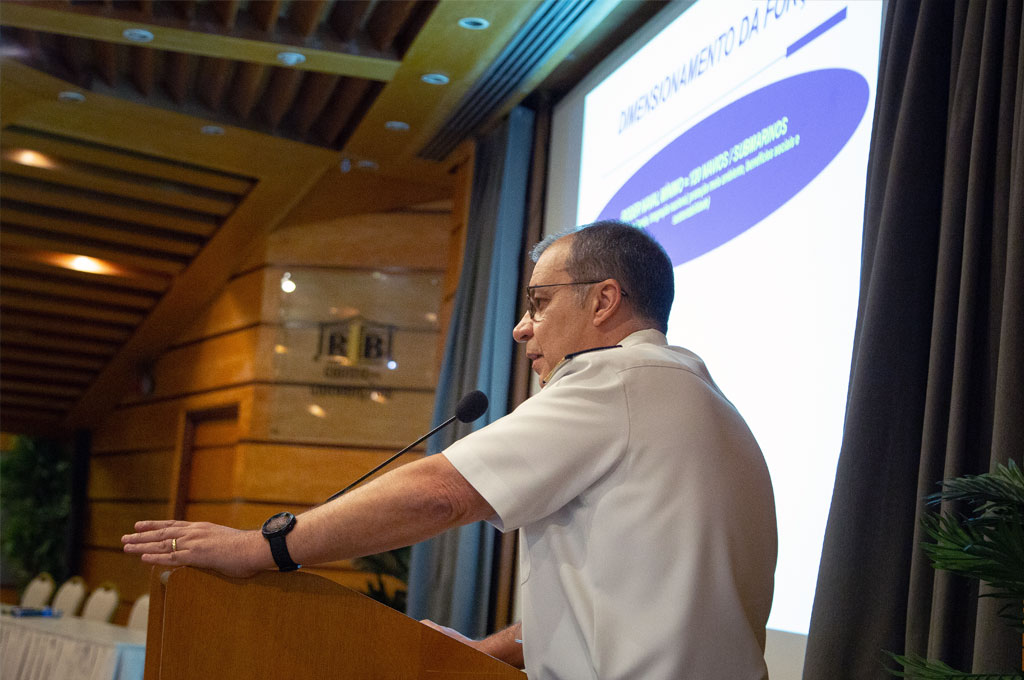

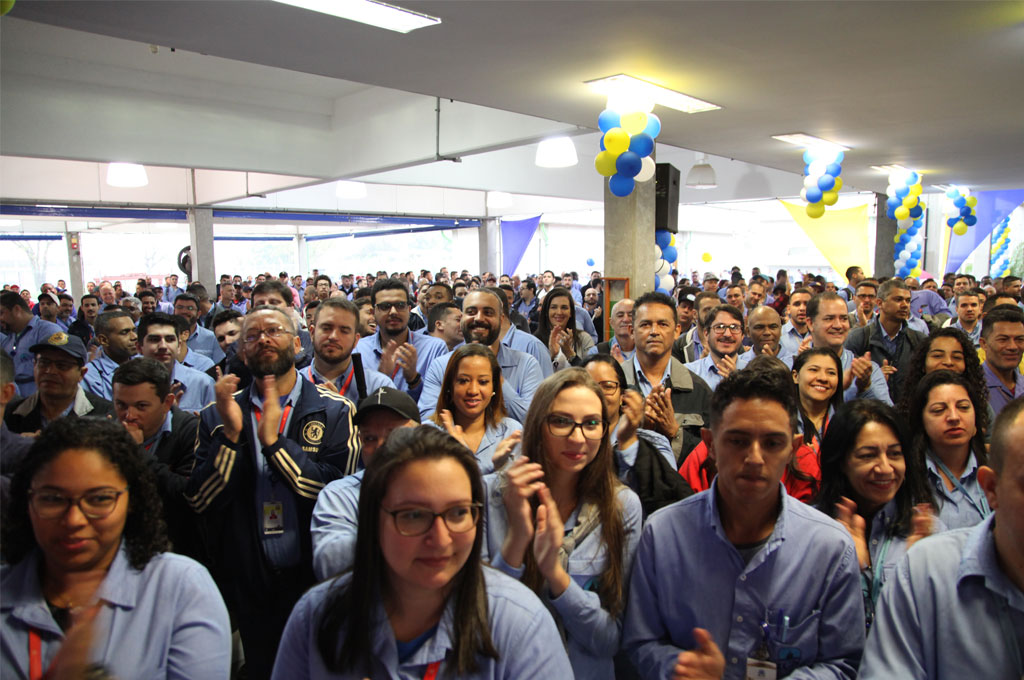
Itaguaí Construções Navais celebrated this Wednesday (21) the tenth anniversary of the creation of the company, which is responsible for executing Prosub, the Brazilian Navy's Submarine Development Program. The date marks a decade since the signing of the ICN statute, formed by partners Naval Group and OEC (Odebrecht Engenharia e Construção). The celebration took place at the shipyard facilities, located in Itaguaí (RJ), with the presence of two thousand members, in addition to representatives of the Brazilian Navy and ICN.
Prosub plans to simultaneously manufacture four conventional submarines, the most modern in the world in this category, and the first nuclear-powered submarine in Latin America, which will bring Brazil into the group of only six countries that have this technology. The second conventional submarine, the Humaitá, will be integrated in October of this year. In December 2018, the first vessel in the program, the Riachuelo submarine, was launched and commissioning tests of the equipment began.
During today's ceremony, ICN President André Portalis emphasized that the great merit of the work of these ten years was the technical qualification, the continuous evolution of the company and the support received from the Brazilian Navy:
– We are proud of the success achieved, especially with the integration of teams, the technology transfer program, and the constant encouragement received from the Brazilian Navy, of which we are an industrial tool and our reason for existing. Our project has already reached several important milestones since 2013, when we started operations at the Ufem (Metal Structures Manufacturing Unit) factory, up to the launch of the Riachuelo submarine at the end of last year.
UFEM is a manufacturing complex with 45 buildings and 57 square meters, built to house the Prosub submarine components factory. In addition to the administrative area, UFEM also consists of a main building with several workshops and a warehouse. The unit was opened in March 2013.
Engineer Pedro Moreira, contract director of the Shipyard and Naval Base (EBN), a space in the ICN complex where submarines are built, and representative of partner OEC, recalled that ICN has become a hub for technological development in the country.
– Our team members developed technical skills that were not previously available. This is one of the great merits of the Prosub program for Brazil's economic development and reaffirms the enormous capacity of national engineering.
Rear Admiral Celso Koga, manager of the General Coordination Office of the Nuclear-Powered Submarine Development Program, recalled how great the challenges were ten years ago:
– Creating ICN, a private company to build our submarines, was not a simple project. But the company proved resilient and trained its workforce in many different areas. We are on the right track to achieve our main goal, which is the construction of the Álvaro Alberto, the first Brazilian submarine with nuclear propulsion.
During the ceremony, Rear Admiral Paulo Demby, head of Institutional Relations and Communications at the Navy's Nuclear and Technological Directorate, recalled that, in addition to being strategic for the country, Prosub stimulated the development of the entire southern region of Rio de Janeiro, where ICN is located.
– A notoriously deteriorated area of Sepetiba Bay has been transformed into a modern shipyard, with state-of-the-art facilities used in the global naval industry, such as a simulator and a ship lift (submarine launching ramp).
Technology transfer
Prosub has led to the development of the entire production chain in Brazil, based on the military technology transfer program between France and Brazil, helping to boost the naval defense industry, qualify the national labor market and generate thousands of highly specialized technical jobs. More than 100 national companies act as suppliers of technology and products for the development of submarines and construction projects. Approximately 90% of all equipment used at the Naval Base Shipyard is purchased from companies based in Brazil. The construction projects, under the responsibility of OEC, have also stimulated the development of new equipment, tailored to the challenge posed by the program.
Source: Ports and Ships