
Source: Ports and Ships / Danilo Oliveira
• Companies see the need for integration to meet the demand for projects of financial and technical magnitude that have not occurred in the Brazilian market for over 10 years
Representatives from different segments of the naval industry believe that the time is right for partnerships to meet the current demands of this market and to broaden the outlook for future opportunities, including the export of products and services to countries that are not currently on the radar. The assessment is that the revival of activities has opened up space for the search for partners that complement each other to meet new projects, after more than a decade of demobilization.
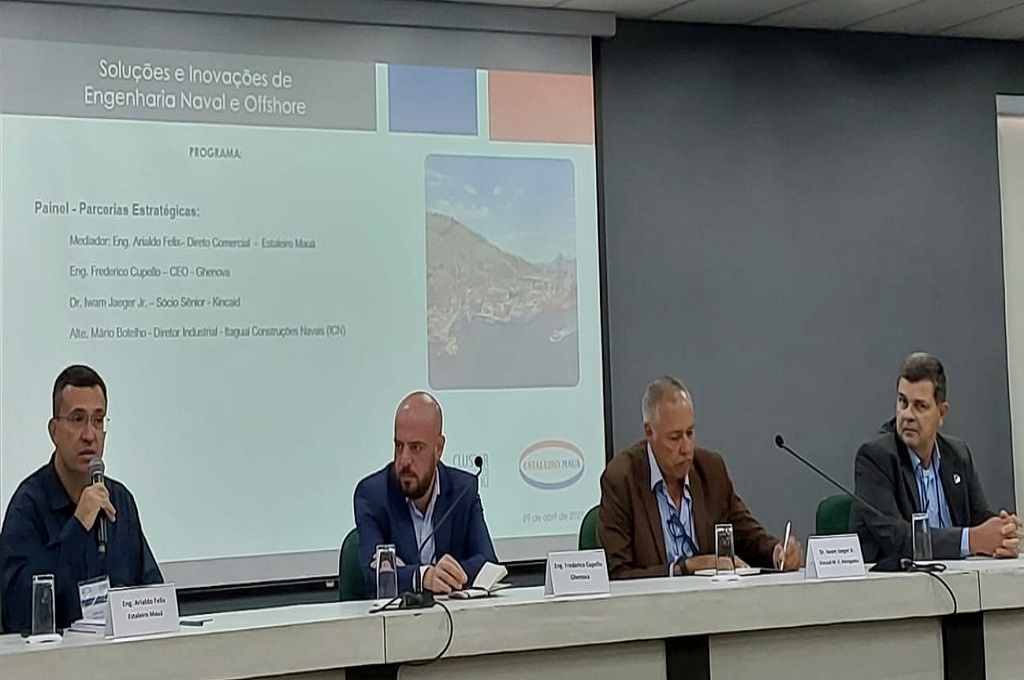
“Partnerships today, even between 'competitors' or 'parts of the same market', are one of the great solutions for the engineering market and for the industry as a whole, to support everything that is to come. (…) At this moment, the market seems a little more inclined to do this differently, actually looking at partnerships as a solution,” assessed the CEO of Ghenova, Frederico Cupello, during an event on solutions and innovations in naval and offshore engineering, last week, at the Mauá Shipyard, in Niterói (RJ).
Cupello stressed that the beginning of a new cycle is always challenging because it presupposes changes in structure, capacity, structure and personnel, for example. He highlighted that, in the first years in Brazil, Ghenova strengthened itself with partnerships and that, even during the construction crisis, it chose to maintain its structure in Brazil and increase its expertise by serving projects in other countries.
Mauá's commercial director, Arialdo Félix, recalled that the partnership with Jurong in the past was important for the shipyard's specialization in the offshore market. "After several years of building ships, we entered the offshore area. It was an important partnership that lasted for some time and then the shipyard went on its way, becoming a reference in shipbuilding, repairs and also in the offshore industry", he highlighted. Recently, the shipyard entered into a partnership with Seatrium (Jurong/Keppel) to manufacture offshore 'pancakes', ordered for Petrobras' P-83. "After so much time, we need this union of companies. It is not easy to add labor after so long without projects", he added.
The industrial director of Itaguaí Construções Navais (ICN), Admiral Mário Botelho, highlighted that the partnership between ICN and Naval Group and other partners is to overcome the challenge of building conventional submarines and, in the future, a significant part of the nuclear-powered submarine. He highlighted the creation of over 60 thousand direct and indirect jobs involved in the entire Prosub, in addition to the more than R$ 2 billion invested in nationalization programs and the qualification of Brazilian supplier companies.
Botelho explained that ICN is seeking international or national partnerships that can guarantee the company's long-term viability, as its only client is the Brazilian Navy, which is dependent on its budget. “We are aiming to become a submarine export hub; the demands of the Southern Cone are significant. The world is driven by rearmament, and countries are increasing their budgetary spending on the defense industry. We see this as an opportunity to pursue this market, which, with these partnerships, will allow us to continue operating and avoid a downturn,” he commented.
Attorney Iwam Jaeger Jr., senior partner at Kincaid Mendes Vianna, noted that one of the difficulties in multinational partnerships is explaining local legal peculiarities to foreign investors. Jaeger mentioned that this type of problem is common in contracts, from charter terms to clauses in facility decommissioning plans (IDPs). He suggested establishing a contractual balance, defining the responsibility matrix and the risk matrix for the parties involved.